
A medical surveillance programme helps employers monitor employee health over time when work involves specific health risks. In South Africa, it should be built around the hazards employees face, the work they perform and the workplace risk assessment.
The process often follows this path:
Risk Assessment → Baseline or Pre-employment Assessment → Periodic Monitoring → Exit Medical → Records and Follow-up
The aim is to make sure the right employees receive the right monitoring at the right time, not to simply send every employee for the same tests.
Start with the workplace risk assessment.
Good medical surveillance planning starts with understanding the workplace.
Employers need to identify hazards, determine which employees may be exposed and consider how that exposure could affect health. Noise, dust, chemicals, heat and other physical agents may require different forms of monitoring.
South Africa’s occupational health rules also link surveillance to workplace risk. For example, the Hazardous Chemical Agents Regulations, 2021 link the need for surveillance to exposure and health risk assessment, while the Noise Exposure Regulations, 2024 connect medical surveillance and audiometric testing to workplace noise exposure and risk assessment.
Mining has its own requirements under the Mine Health and Safety Act, including medical surveillance for employees exposed to health hazards.


Establish a baseline before or near the start of exposure.
Once the relevant employee groups have been identified, the next step is to establish a health baseline.
A baseline assessment, which may form part of a pre-employment medical, records relevant health information before or close to when an employee starts a role or begins exposure to a workplace hazard. This gives the occupational health practitioner a reference point for future results.
Depending on the role and exposure, the assessment may include a physical examination, audiometry, spirometry, vision screening or other appropriate tests.
Use periodic monitoring to track change.
A medical surveillance programme is designed to follow relevant health indicators over time.
Periodic medicals allow current findings to be compared with earlier results. This can help identify changes that need further investigation.
For example:
- employees exposed to workplace noise may require audiometric testing
- employees exposed to dust or fumes may require spirometry
- selected respiratory risks may call for occupational chest X-rays
- some chemical exposures may require biological monitoring alongside medical surveillance
- safety-critical roles may require vision or fitness assessments
The frequency and type of testing should be based on the employee’s role, exposure profile, applicable requirements and occupational health guidance.
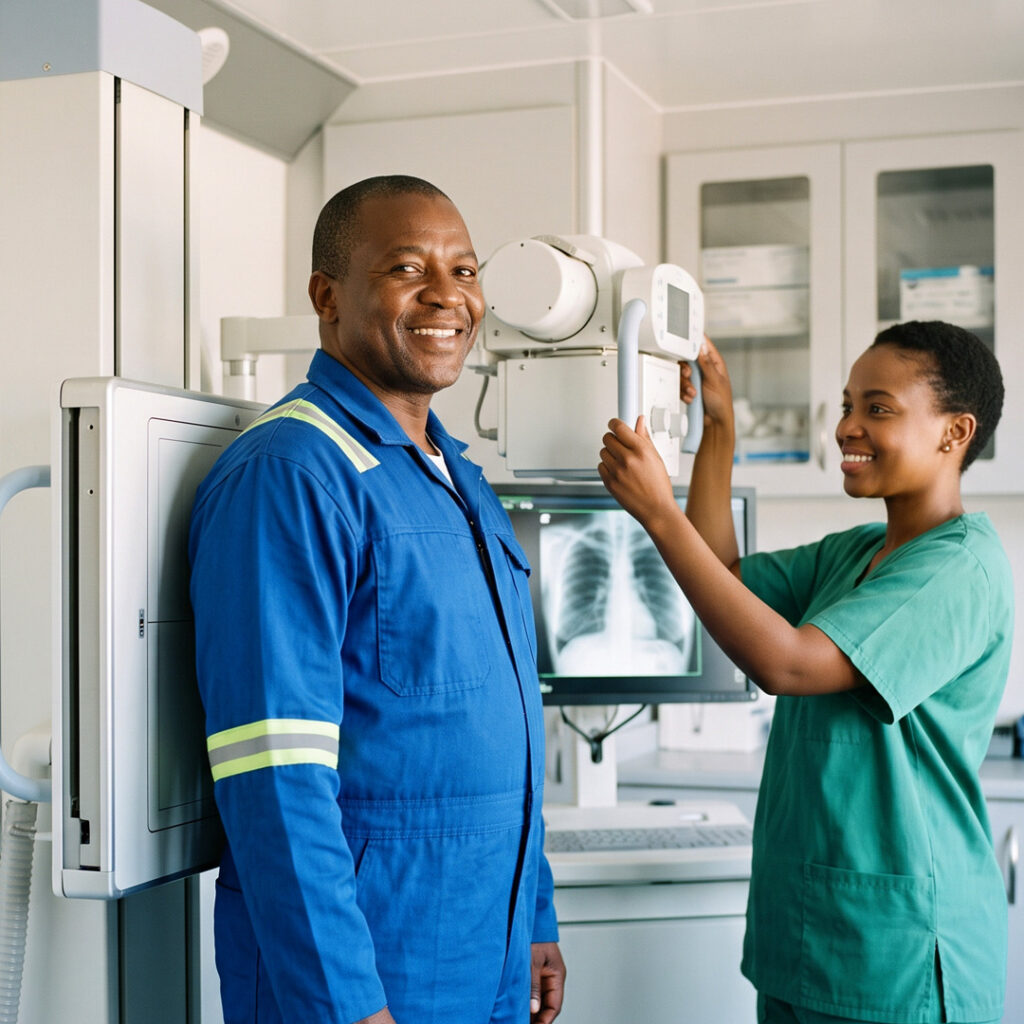
Complete an exit medical where required.
The final stage may be an exit medical when employment ends, or the employee leaves a role involving occupational exposure.
An exit assessment provides a final occupational health record that can be considered alongside the employee’s baseline and periodic results.
This helps the employee medical surveillance programme show what happened across the period of exposure, rather than only during one medical examination.
Keep records and follow up on abnormal findings
Testing is only one part of workplace medical surveillance management.
Results must be recorded correctly, and employee medical information must remain confidential. Employers should receive the occupational health information needed to manage workplace risk while private medical details remain protected.
Where a result changes or falls outside the expected range, the occupational health practitioner may recommend repeat testing, further clinical assessment, referral or a review of the employee’s work and exposure.
A pattern across several employees may also point to a workplace issue and the need to review exposure controls.
Review the programme when workplace risks change.
Medical surveillance programme management should not be treated as a once-off setup.
The programme may need to change when new processes, substances, equipment or job duties are introduced. Changes to the risk assessment or exposure profile may also mean that different employee groups or tests need to be considered.
Regular review keeps occupational medical programme management linked to the risks actually present in the workplace.

Build medical surveillance around the workforce.
A well-planned medical surveillance programme connects workplace risk with employee health throughout the employment cycle.
IHSS supports South African employers with risk-based occupational health services delivered through clinic, mobile and on-site options. This allows assessments and periodic monitoring to align with workforce numbers, shifts, and operational requirements.
The strongest programmes connect risk assessment, baseline information, periodic monitoring, exit medicals, records and follow-up into one clear occupational health surveillance programme.
Speak to IHSS about planning a medical surveillance programme around your workforce and workplace risks.